



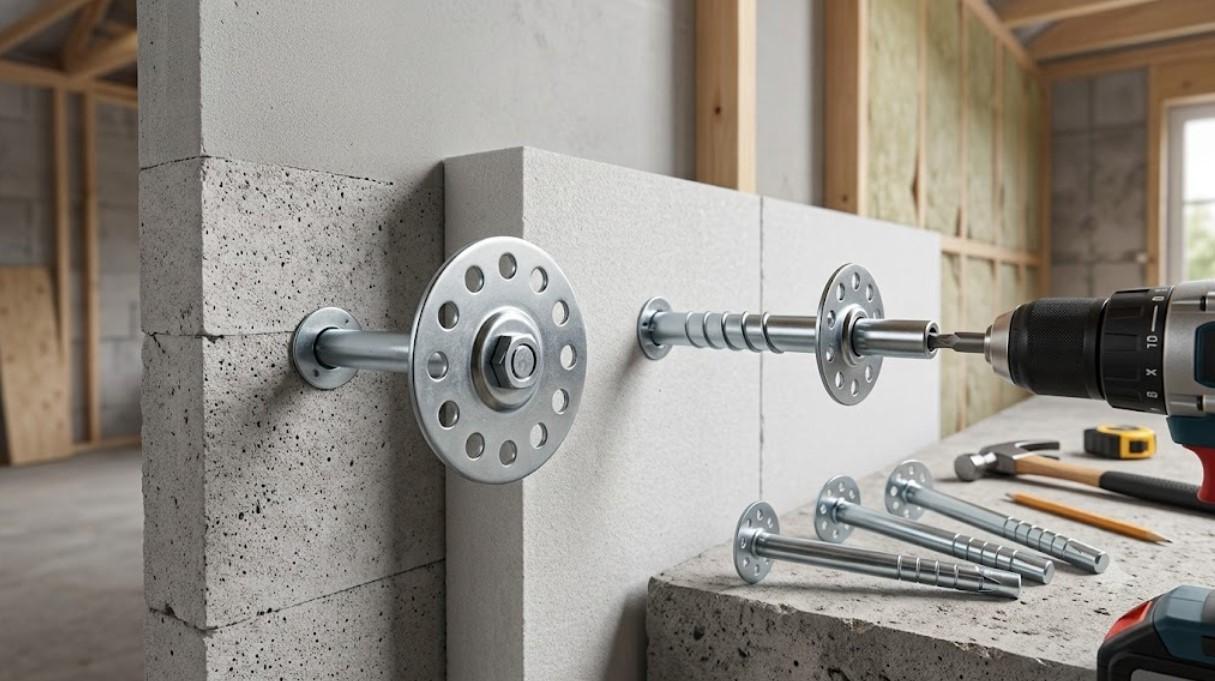
Rockwool insulation is widely used in commercial, industrial, and HVAC projects for its excellent thermal, fire-resistant, and acoustic properties. However, the effectiveness of Rockwool insulation depends not only on the insulation material itself but also on how securely it is installed.
This is where Rockwool pins, also known as insulation pins or hanger pins, play a vital role. These specialized insulation pins securely fasten Rockwool boards and blankets to ducts, tanks, walls, ceilings, and industrial equipment for long-lasting stability.
This guide covers what Rockwool pins are, their types, common applications, and the correct installation process.
Rockwool pins are metal fastening systems used to mechanically secure Rockwool insulation to various surfaces. They consist of a metal pin or spindle attached to a base, with a self-locking washer or speed clip that holds the insulation tightly against the surface after installation.
Depending on the application, insulation pins can be welded, self-adhesive, or fixed using industrial adhesives and are commonly made from stainless steel, galvanized steel, or aluminum for superior durability & corrosion resistance.
For reliable insulation fastening solutions, choose a trusted Rockwool insulation pin supplier UAE offering high-performance pins for HVAC and industrial applications.
Without proper fastening, insulation can shift, sag, or detach over time due to vibration, gravity, temperature changes, or airflow. Properly installed Rockwool pins offer several important benefits:
In industrial facilities and HVAC systems, properly secured insulation also helps preserve acoustic performance and energy efficiency.
Different applications require different fastening methods. The most commonly used Rockwool pins include:
Self-adhesive pins feature a pressure-sensitive adhesive backing protected by a peel-off paper. Once the installation surface is cleaned, the backing is removed, and the pin is pressed firmly onto the substrate.
Best for:
Advantages
These pins should only be installed on clean, dry, and grease-free surfaces to ensure proper adhesion.
Perforated base pins have multiple holes in the metal base, allowing construction adhesive or insulation adhesive to bond through the base for a stronger mechanical connection.
Best for:
Advantages
Welded insulation pins are permanently attached to metal surfaces using stud welding equipment. The Rockwool insulation is then pushed onto the pin and secured with a locking washer.
Best for:
Advantages
Many Rockwool installation guidelines recommend welded pins for large ductwork and industrial insulation systems because they provide reliable long-term support.
Rockwool pins are used across numerous industries where insulation needs secure mechanical fastening.
Heating, ventilation, and air-conditioning ducts commonly use insulation pins to hold Rockwool duct insulation securely in place while preventing movement caused by airflow.
Boilers, storage tanks, heat exchangers, reactors, pressure vessels, and process equipment rely on insulation pins to support high-density Rockwool insulation.
Commercial buildings use insulation pins for:
Ships and offshore platforms often use welded insulation pins because they withstand harsh environments, vibration, and corrosion.
Proper installation is essential for ensuring insulation remains secure throughout its service life.
Clean the installation surface thoroughly to remove:
A clean surface is critical, especially for self-adhesive and adhesive-fixed pins.
Mark the required pin locations according to the insulation board size and project specifications.
Pin spacing varies depending on:
Many installation guides recommend approximately 300 mm spacing and sufficient pins around edges to prevent sagging.
Install the chosen pin type:
Push the Rockwool board or blanket carefully over each pin until it sits flush against the surface.
Avoid compressing the insulation excessively, as this can reduce its thermal performance.
Place a self-locking washer onto each pin and press it firmly against the insulation to hold it securely.
Trim or bend excess pin length where required and follow safety practices to prevent injury from exposed pin ends.
For the best results, follow these industry best practices:
Selecting the correct insulation pin depends on several factors, including:
For heavy-duty industrial or high-temperature applications, welded pins generally provide the strongest and most reliable solution. Self-adhesive pins are ideal for lighter indoor HVAC installations, while perforated-base pins offer a durable adhesive-fixed option where welding is not practical.
High-quality Rockwool pins are essential for securing insulation, improving thermal efficiency, fire safety, acoustic performance, and long-term durability across HVAC, industrial, commercial, and marine applications.
Choosing the right insulation pins and installing them correctly minimizes maintenance, prevents insulation failure, and ensures a reliable, professional insulation system for years to come.
Looking for premium-quality Rockwool pins for your next insulation project? Hamza Fasteners, one of the best fasteners suppliers in UAE, offers durable insulation pins and expert fastening solutions for HVAC, industrial, commercial, and marine applications.
Contact our insulation fastening experts today for expert guidance and dependable fastening solutions tailored to your project requirements.
Discover in-depth guides and practical insights to help you make informed decisions across industrial fastening and engineering applications.
November 14, 2024
November 28, 2024
December 14, 2024
December 28, 2024
January 17, 2025
All Rights Reserved © Hamza Fasteners