



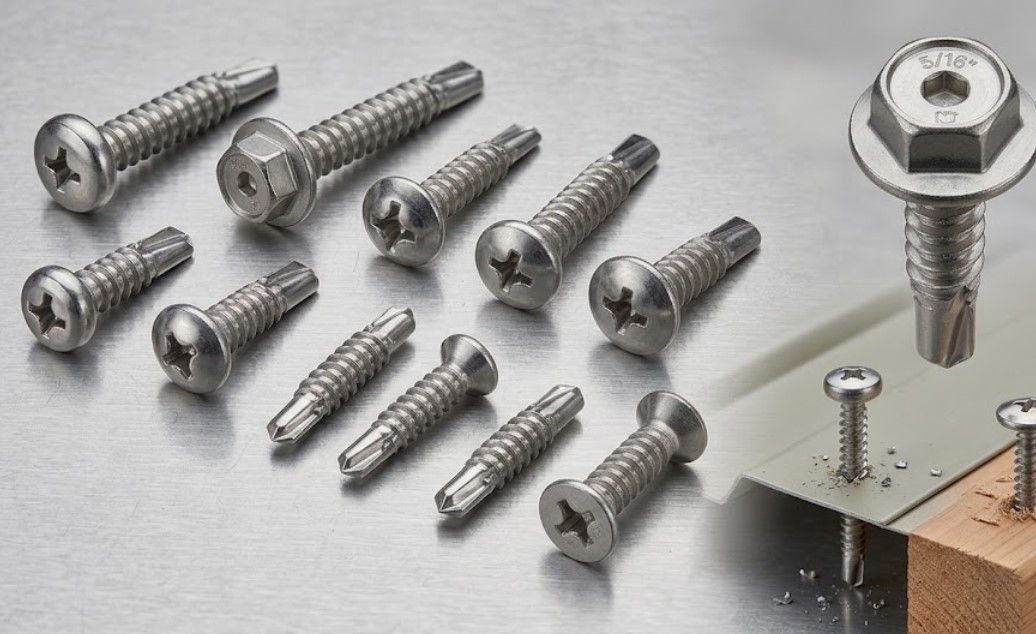
Self-drilling screws are one of the most efficient fastening solutions used across construction, manufacturing, and industrial projects.
Whether you are fastening metal sheets to steel frames, installing roofing panels, or assembling HVAC ductwork, these screws eliminate the need for a separate drilling step and deliver a secure, long-lasting hold in a single operation.
This guide covers everything you need to know about self-drilling screws, from how they work and what makes them different from self-tapping screws, to the various types available and how to select the right one for your application.
Self-drilling screws are fasteners engineered with a built-in drill-shaped point that allows them to bore through materials, cut their own threads, and complete the fastening process all in one single action.
Unlike conventional screws that require a pre-drilled pilot hole, these screws combine the function of a drill bit and a fastener in one tool.
They are widely known as Tek screws, a name that originated from a popular manufacturer but has since become a general industry term for this type of fastener. The term SDS, which stands for self-drilling screw, is also used interchangeably in construction and engineering environments.
The defining characteristic of a self-drilling screw is its tip. The point is shaped like the tip of a twist drill bit, complete with cutting flutes that allow it to penetrate hard materials such as steel, aluminium, and dense timber without any pre-drilling required.
This is the most common source of confusion in the fastener industry. The two terms are often used interchangeably, but they describe different products with different capabilities.
| Feature | Self-Drilling Screws | Self-Tapping Screws |
|---|---|---|
| Tip Design | Integrated drill bit with cutting flutes | Sharp pencil-like point |
| Pilot Hole Required | No | Yes, in steel and hard materials |
| Thread Cutting | Yes, drills and taps in one step | Yes, but needs a pre-drilled hole first |
| Best Used For | Steel to steel, steel to timber, light gauge steel | Plastic, wood, thin sheet metal, aluminium |
| Installation Speed | Faster, single operation | Slower, requires a separate drilling step |
A self-drilling screw has a true drill point that penetrates hard substrates independently. A self-tapping screw can form threads but needs a pilot hole in harder materials.
All self-drilling screws are self-tapping by function, but not all self-tapping screws are self-drilling. Using the wrong type can result in thread stripping, weak joints, or substrate damage.
The installation process with self-drilling screws is straightforward and much faster than traditional fastening methods. When the screw is driven into a material using a power drill, the drill-shaped tip cuts into the surface first, creating a hole.
As the screw continues to advance, the threaded shank engages with the material and forms or cuts a mating thread. By the time the head seats against the surface, drilling, tapping, and fastening are all complete.
This three-in-one action is what gives self-drilling screws their significant time and efficiency advantage over other fastening methods that require separate drilling and threading steps.
To install self-drilling screws correctly, a drill with a hex adapter is typically used. The screw is fitted onto the adapter, positioned at the marked point on the material, and driven steadily without excessive force.
Applying too much pressure generates unnecessary heat at the drill tip, which can cause the point to wear out prematurely or fail.
Self-drilling screws are available in different designs to suit specific materials, applications, and installation requirements. They are commonly available in both fine-thread and coarse-thread options.
Countersunk self-drilling screws are designed to sit flush with the material surface, creating a smooth and professional finish. They are widely used in construction, fabrication, and metalworking applications where a protruding screw head is undesirable.
Low profile self-drilling screws feature a shallow head design that provides a neat appearance while minimising protrusion. Common variants include wafer-head, pancake-head, and baypole screws, making them suitable for ductwork, interior fit-outs, and light steel construction.
Self-drilling screws with wings are designed for fastening timber, composite panels, or similar materials to steel substrates. The wings create clearance in the outer material before breaking away upon contact with the steel, allowing the threads to engage securely and form a strong joint.
Choosing the appropriate type of self-drilling screw ensures efficient installation, reliable performance, and long-lasting fastening results.
Self-drilling screws are widely used across construction, manufacturing, and industrial sectors because they drill and fasten in a single operation, saving time and labour.
Metal Roofing and Cladding: Used to secure steel and aluminium roofing sheets, often with neoprene washers that help create a weather-resistant seal.
Steel Framing Construction: Ideal for connecting steel studs, tracks, and channels in light gauge steel structures.
HVAC and Ductwork: Commonly used for assembling duct sections, brackets, and support components.
Sheet Metal Fabrication: Suitable for joining sheet metal panels in enclosures, machinery, furniture frames, and other fabricated products.
Fencing and Outdoor Structures: Galvanised and stainless steel variants provide reliable fastening for fences, pergolas, carports, and other outdoor installations.
General Construction: Frequently used in sheds, steel frameworks, battens, subframes, and a variety of building projects.
For dependable fastening solutions in the UAE, choose a trusted self drilling screw supplier offering quality products for construction, industrial, and outdoor applications.
The material of a self-drilling screw plays a key role in its strength, durability, and corrosion resistance.
Carbon Steel: The most common material for self-drilling screws, offering high strength and hardness. These screws are typically heat-treated and coated to improve corrosion resistance.
Stainless Steel: Provides excellent resistance to rust and corrosion, making it ideal for outdoor, coastal, and moisture-prone environments.
Bi-Metal Construction: Combines a hardened steel drill point with a stainless steel body, delivering both superior drilling performance and long-term corrosion protection.
Selecting the right material and coating helps ensure reliable performance and longer service life in any application.
Selecting the right self-drilling screw is essential for achieving a secure, durable, and efficient fastening solution. The choice depends on the material, application, and environmental conditions.
Material Thickness: Choose a drill point suitable for the thickness of the material being fastened. Thinner metals require smaller drill points, while thicker steel sections need longer drill points for proper penetration.
Thread Type: Fine-thread screws are best for metal-to-metal connections, while coarse-thread screws provide stronger grip in timber and other softer materials.
Head Style: Hex head screws are ideal for roofing and structural applications, whereas countersunk and pan head screws are preferred where a neat, low-profile finish is required.
Corrosion Resistance: For outdoor or moisture-prone environments, select galvanised, stainless steel, or coated screws to ensure long-term protection against rust and corrosion.
Length and Diameter: The screw should be long enough to achieve secure thread engagement and strong holding power without compromising installation quality.
Choosing the correct self-drilling screw improves performance, extends service life, and helps ensure reliable results across construction and industrial applications.
The widespread adoption of self-drilling screws across construction, manufacturing, and industrial sectors comes down to a combination of practical and economic advantages.
They eliminate the pre-drilling step entirely, which reduces labour time significantly on projects involving hundreds or thousands of fastenings. This single factor can make a material difference to project timelines and labour costs.
They produce consistent results because the drill point geometry is precisely engineered to suit specific material thicknesses. Each screw drills and threads to a predictable depth and torque, which reduces the risk of overdriving, stripping, or inconsistent fastening quality.
They are available in a comprehensive range of sizes, materials, coatings, and head styles, which means there is a self-drilling screw solution for almost any combination of materials, environment, and performance requirement.
For contractors and project managers in the UAE sourcing high-quality fastening solutions, self-drilling screws that meet the corrosion resistance demands of Gulf region environments are available from reputable suppliers with technical expertise to support specification decisions.
Self-drilling screws offer a fast, efficient, and reliable fastening solution for construction, HVAC, roofing, fabrication, and industrial applications. Choosing the right screw type, thread, and material ensures strong performance and long-term durability.
Hamza Fasteners Building Materials Trading supplies high-quality self-drilling screws and industrial fasteners designed to meet UAE project requirements.
Contact our experts today to find the right fastening solutions for your specific application needs.
Discover in-depth guides and practical insights to help you make informed decisions across industrial fastening and engineering applications.
November 14, 2024
November 28, 2024
December 14, 2024
December 28, 2024
January 17, 2025
All Rights Reserved © Hamza Fasteners