


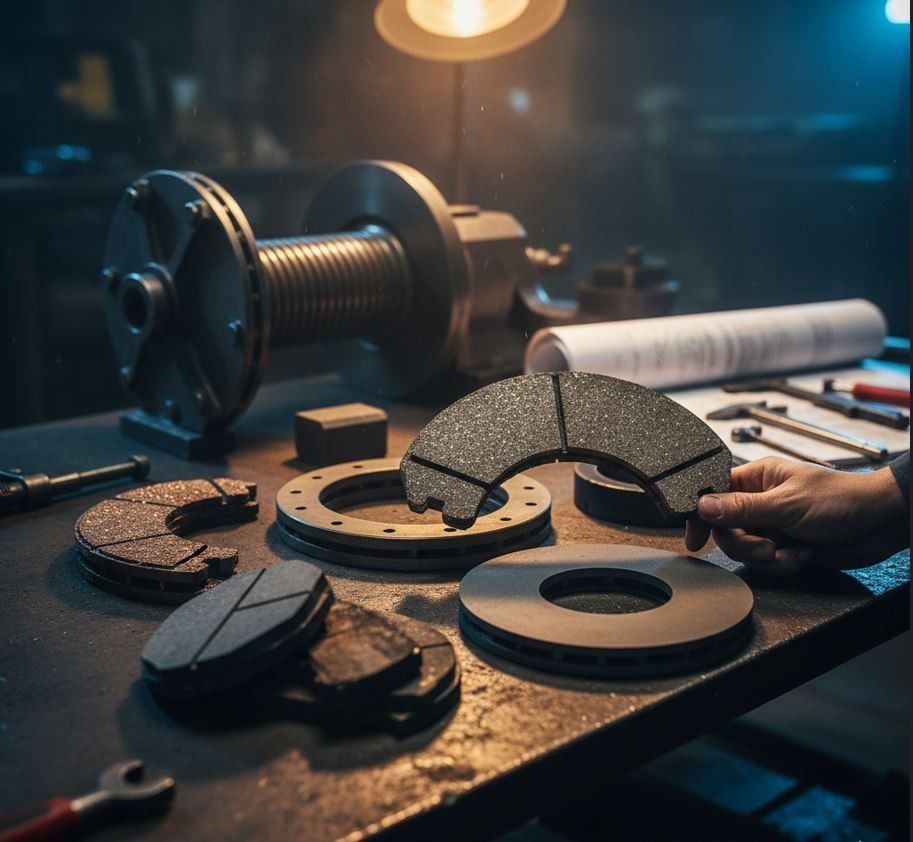
Whether you operate a marine mooring winch, an offshore crane, or a heavy-duty industrial lifting system, the reliability of your equipment ultimately depends on one component that rarely gets the attention it deserves: the winch brake lining. A wrong material choice, poor fitment, or delayed replacement can lead to thermal failure, drum slippage, or uncontrolled load release.
This practical buying guide gives you everything you need to make a confident, informed decision.
A winch brake lining is a friction material bonded or riveted to the brake band or shoe of a winch drum. Its job is to generate controlled resistance that slows, holds, or stops the drum under load. In marine applications, regulatory frameworks such as SOLAS (Safety of Life at Sea) require mooring winches to maintain braking capacity equal to 60 to 80 percent of the line’s Minimum Breaking Load (MBL). This makes lining selection a compliance issue, not merely a mechanical one.
In industrial environments, the winch braking system must be matched to the duty cycle of the application, including load weight, drum speed, and environmental exposure. A mismatch here does not just reduce efficiency; it creates a direct safety hazard for personnel and equipment.
Woven semi-metallic linings are constructed from interlaced metallic and organic fibers, producing a dense, heat-resistant structure. These are widely used in heavy-duty marine and industrial winches due to their superior thermal stability and long service intervals.
They offer excellent performance in high-load mooring applications where consistent brake drum friction is essential throughout extended operations.
Modern non-asbestos brake linings formulations use aramid fibers, resins, and mineral compounds to replicate the friction properties of older asbestos-based materials. These comply with international health and environmental regulations and are increasingly the standard across commercial shipping and industrial sectors.
NAO linings provide reliable mid-range friction and are ideal for winches operating in moderate temperature environments.
High-friction composite brake linings are engineered for extreme applications where thermal load and mechanical stress peak simultaneously. These materials are reinforced with ceramic or carbon particles, offering exceptional fade resistance and dimensional stability under sustained braking.
They are the preferred choice for offshore crane winches, anchor windlasses, and high-tension mooring systems.
For vessel operators, selecting the correct ship brake lining demands a marine-specific approach. Mooring winches operate under dynamic tension, saltwater exposure, and strict classification society requirements. The selection must prioritise high friction output, extreme thermal resistance, and long-term durability in harsh marine environments.
Woven semi-metallic and high-friction composite linings are the preferred solutions for heavy mooring loads, and all materials must be fully asbestos-free to comply with current IMO regulations and port state control standards. For a detailed overview, read our blog on Brake Lining: Types, Materials and Applications.
Marine brake lining specifications should always be verified against classification requirements to ensure compliance, material certification accuracy, and safe operational performance.
Even the highest-quality winch brake lining replacement delivers diminishing returns without consistent maintenance. After every major operational period, inspect the lining surface for glazing, cracking, or uneven wear. Keep brake surfaces completely free of oil, grease, and saltwater residue, as contamination sharply reduces the effective friction coefficient and can cause sudden braking failure.
Lubricate pivot points and pins carefully without allowing lubricant to contact the friction surface. Document lining thickness at each inspection interval to predict replacement intervals accurately. For winches in continuous service, keeping a spare set of pre-fitted linings on hand minimises downtime during unscheduled inspections or emergency replacements.
A brake lining generates friction to hold, slow, or stop a winch drum under load. It is the primary contact element that converts drum motion into controlled braking resistance.
Replace the lining when thickness falls below 6.4mm or when you observe glazing, cracking, or inconsistent braking. Proactive replacement during scheduled maintenance is always safer than waiting for failure.
Marine winch brake linings are typically made from woven semi-metallic or non-asbestos high-friction composite materials. These maintain stable friction in damp, corrosive saltwater environments under heavy mooring loads.
SOLAS requires mooring winches to hold 60 to 80 percent of the mooring line’s minimum breaking load (MBL). Selecting linings with the correct friction coefficient and thermal rating is essential to meet this standard.
Selecting the right winch brake lining is a decision that directly affects the safety of your crew, the integrity of your equipment, and your compliance with marine and industrial regulations. From matching friction coefficients to SOLAS MBL requirements, confirming bonding methods, and scheduling proactive replacements, every step in the selection process matters. Taking a systematic approach ensures your braking system performs reliably across every operational demand.
For industrial operators and vessel owners across the Middle East and Africa, Hamza Fasteners Building Materials Trading LLC supplies a comprehensive range of certified, asbestos-free winch brake linings in woven, composite, and moulded variants, complete with full material datasheets, dimensional customisation, and dedicated technical support.
Reach out to our brake lining specialists to equip your winch systems with materials built for safety, compliance, and long-term performance.
Discover in-depth guides and practical insights to help you make informed decisions across industrial fastening and engineering applications.
November 14, 2024
November 28, 2024
December 14, 2024
December 28, 2024
January 17, 2025
All Rights Reserved © Hamza Fasteners