


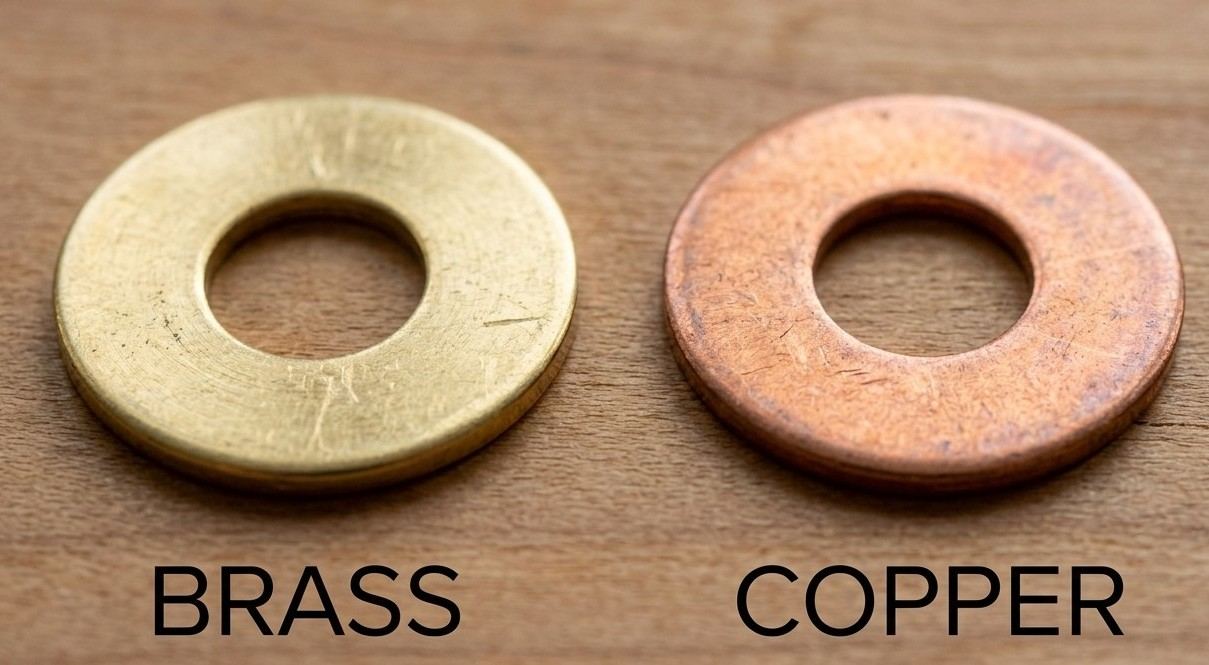
Washers are essential fastening components used to distribute load, protect surfaces, and improve the reliability of bolted connections. Among the many metal washer options available, brass washers and copper washers are widely used in industrial, electrical, plumbing, automotive, and engineering applications.
Although both materials offer good corrosion resistance and electrical conductivity, they have different properties. Understanding the difference between brass and copper washers helps you choose the right washer for your application.
Brass washers are flat metal washers made from a copper and zinc alloy. The addition of zinc gives brass greater hardness and strength than pure copper.
Brass washers are valued for their durability, corrosion resistance, attractive finish, and good electrical conductivity. They are commonly used where a strong and reliable fastening component is required.
Brass washers are often used in:
Their combination of strength and corrosion resistance makes brass washers suitable for applications where standard steel washers may not provide the desired performance.
Copper washers are sealing and fastening components manufactured from copper. Copper is softer and more ductile than brass, allowing copper washers to deform more easily when compressed.
This property makes them particularly useful for creating reliable seals between mating surfaces. Copper washers are commonly found in hydraulic systems, automotive components, plumbing connections, and high temperature applications.
Copper washers are widely used for:
Copper’s excellent thermal and electrical conductivity also makes it useful in applications where heat dissipation or electrical performance matters.
The main difference between brass and copper washers is their material composition and mechanical properties.
| Feature | Brass Washers | Copper Washers |
| Material | Copper and zinc alloy | Copper |
| Mechanical strength | Generally higher | Generally lower than many brass alloys |
| Hardness | Generally higher | Generally lower |
| Ductility | Moderate to high, depending on alloy | High |
| Electrical conductivity | Lower than copper | Higher than brass |
| Thermal conductivity | Lower than copper | Higher than brass |
| Sealing applications | Suitable for selected applications | Commonly used for crush sealing |
| Corrosion behavior | Depends on alloy and environment | Depends on grade and environment |
| Appearance | Yellow or golden | Reddish or pinkish brown |
| Common applications | Fastening, electrical and decorative hardware | Sealing, electrical, automotive and plumbing |
If your primary requirement is sealing, copper washers are often the preferred option. Their softness allows them to compress and conform to small surface imperfections.
This makes copper sealing washers useful for oil, fuel, hydraulic, and plumbing connections. They can provide a dependable seal when properly selected and installed.
Brass washers can also be used in sealing applications, but their greater hardness means they do not deform as easily as copper.
In most applications, brass washers are stronger and harder than copper washers. This makes them a good choice when the washer needs to withstand mechanical loads while maintaining its shape.
Copper is softer, but this is not necessarily a disadvantage. Its softness provides better compressibility, making copper washers particularly effective for sealing applications.
Both brass and copper offer good resistance to corrosion, but their performance depends on the environment.
Copper performs well in many plumbing and industrial environments, while brass is commonly selected for hardware exposed to moisture, water, and general atmospheric conditions.
For demanding environments, the exact alloy, operating temperature, chemicals, and exposure conditions should be considered before selecting a washer.
Copper washers generally provide better electrical conductivity than brass washers. This makes copper a strong choice for electrical grounding, terminals, and conductive connections.
Brass washers are also used in electrical applications because they provide a useful balance of conductivity, strength, and corrosion resistance.
When electrical performance is the main priority, copper is usually the better material. When mechanical strength is equally important, brass may be more suitable.
The right washer depends on the requirements of your application.
Choose brass washers when you need:
Choose copper washers when you need:
If you are sourcing brass washers for a construction, engineering, or industrial project, choosing an experienced brass washers supplier UAE can make it easier to find the right sizes, specifications, and material options for your application.
Before purchasing industrial washers, consider the following factors:
Select brass or copper based on the mechanical, electrical, and sealing requirements of the application.
Washer dimensions must match the bolt or screw. Check the inner diameter, outer diameter, and thickness to ensure proper fit.
For heavily loaded fastening connections, a harder brass washer may provide better support. Softer copper washers are better suited to applications where compression and sealing are important.
Consider moisture, chemicals, temperature, pressure, and exposure to corrosive substances when selecting washer materials.
Identify whether the washer is primarily needed for load distribution, electrical conductivity, surface protection, or sealing. This will help determine the most suitable material.
The difference between brass and copper washers mainly comes down to strength, hardness, conductivity, and sealing performance. Brass washers provide greater mechanical strength and durability, while copper washers offer excellent conductivity, ductility, and sealing properties.
For fastening, electrical, plumbing, automotive, and industrial applications, selecting the right washer material can improve connection reliability and service life. If you are comparing metal washers for a specific application, Hamza Fasteners Building Materials Trading LLC can help you understand the available options and choose a suitable fastening solution.
For guidance on washer selection, sizes, and applications, contact our team to discuss your requirements.
November 14, 2024
November 28, 2024
December 14, 2024
December 28, 2024
January 17, 2025
All Rights Reserved © Hamza Fasteners