


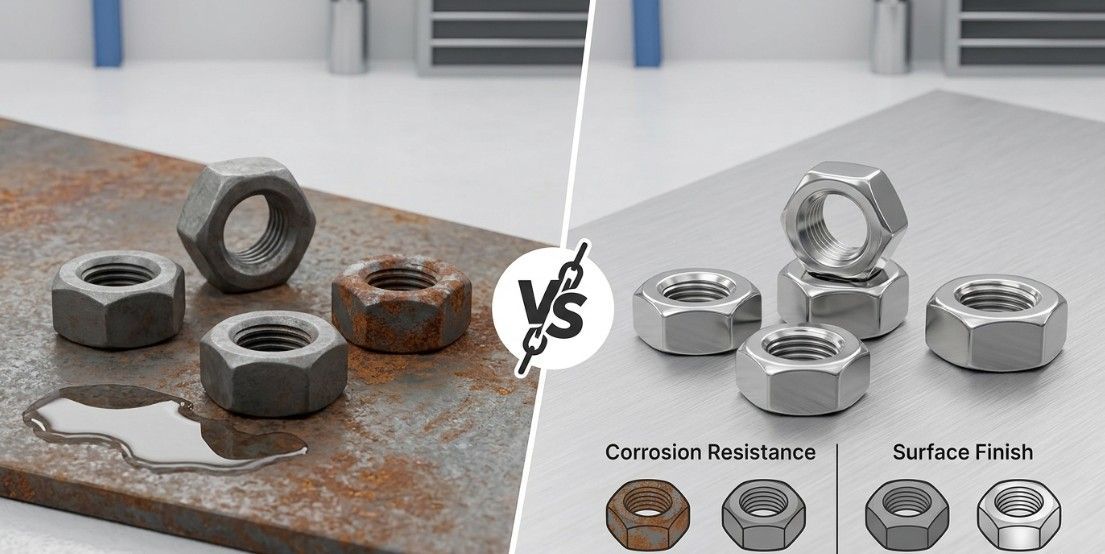
In sectors such as construction, manufacturing, and industrial maintenance, a clear understanding of the differences between mild steel and stainless steel hex nuts is crucial to prevent premature failure, control lifecycle costs, and ensure operational reliability.
This comprehensive guide provides a structured analysis of material properties, applications, cost considerations, and buyer evaluation criteria, aligned with real world usage and search intent to support informed decision making.
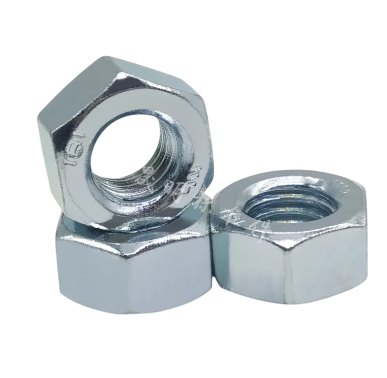
Hex nuts are six sided fasteners used with bolts and threaded rods to secure components. They are essential in structural assemblies, machinery, pipelines, and fabrication work.
Stainless steel hex nuts are threaded fasteners made from corrosion resistant alloys containing chromium, which forms a protective oxide layer on the surface.
Stainless steel hex nuts are commonly used in marine, outdoor, and industrial applications where corrosion resistance, durability, and long term performance are critical.
Mild steel hex nuts are fasteners made from low carbon steel, valued for their strength, ductility, and cost efficiency. They are commonly coated with zinc or galvanization to provide basic corrosion protection in moderate environments.
Mild steel hex nuts are commonly used in structural assemblies, machinery, and general fabrication where strength and cost efficiency are important, especially in controlled or indoor environments, making MS fasteners a reliable and widely preferred choice for such applications.
One of the most important factors to consider is corrosion resistance. Stainless steel hex nuts are designed with a chromium rich composition that forms a protective layer, allowing them to perform exceptionally well in humid, outdoor, and chemical environments.
Mild steel hex nuts rely on protective surface coatings such as zinc plating or galvanization to resist corrosion. While these coatings offer effective initial protection, they gradually degrade with exposure to moisture and environmental conditions, leaving the base metal vulnerable to rust over time.
Mild steel hex nuts are well known for their strong load bearing capability, making them a dependable choice for structural and general engineering applications where strength is a priority.
Stainless steel hex nuts also provide reliable mechanical performance, but they are more commonly selected for their corrosion resistance and durability. With the correct grade and sizing, they perform efficiently across a wide range of applications.
In terms of longevity, stainless steel hex nuts offer a clear advantage. Their resistance to corrosion allows them to maintain performance over extended periods with minimal maintenance.
Mild steel hex nuts can perform well in controlled environments, but in exposed conditions, they may require regular inspection, recoating, or replacement to maintain effectiveness.
Cost considerations often influence material selection. Mild steel hex nuts are more affordable upfront, making them ideal for large scale or budget sensitive projects.
Stainless steel hex nuts come at a higher initial cost but often provide better long term value by reducing maintenance, downtime, and replacement frequency, especially in demanding environments
For large scale construction and heavy duty applications where strength and budget optimization are critical, contractors often select mild steel hex nuts from trusted suppliers to ensure reliable load performance while maintaining cost efficiency across the project.
Stainless steel hex nuts feature a clean, polished finish that is well suited for visible or architectural applications. In contrast, mild steel hex nuts typically have a more industrial appearance and are commonly used in functional or concealed installations.
Mild steel hex nuts are widely used due to their strength and cost efficiency. However, in humid or exposed environments, stainless steel reduces maintenance and improves longevity.
Exposure to moisture and salt accelerates corrosion. In such cases, stainless steel, especially 316 grade, provides significantly better performance and durability.
For long term reliability in these demanding conditions, contractors and engineers often prefer using stainless steel hex nuts from a trusted supplier to ensure consistent corrosion resistance and extended service life.
Stainless steel hex nuts are preferred due to their resistance to chemicals, temperature changes, and corrosion, ensuring consistent performance.
Stainless steel is the standard choice due to its non-reactive nature and ease of cleaning, making it suitable for food processing and medical use.
Using mild steel and stainless steel fasteners together can lead to galvanic corrosion in certain environments. Compatibility should always be considered during selection.
Selecting fasteners based only on cost or indoor use assumptions can lead to premature failure when exposed to humidity or outdoor conditions.
Choose mild steel hex nuts when:
Choose stainless steel hex nuts when:
Mild steel vs stainless steel hex nuts depend on strength, corrosion resistance, and cost. Stainless steel offers long term durability and low maintenance, while mild steel provides affordable strength for controlled environments.
They are best suited for indoor, dry environments and structural applications where cost efficiency is important.
They are ideal for outdoor, marine, chemical, and hygienic environments requiring corrosion resistance.
Yes, especially if they are not coated or are exposed to moisture over time.
Not always, mild steel can offer higher strength in some cases, but stainless steel provides better durability in corrosive environments.
Choosing between mild steel and stainless steel hex nuts requires a clear understanding of your project’s environment, load requirements, and long-term expectations. Mild steel offers a cost effective and reliable solution for controlled conditions, while stainless steel delivers superior durability and corrosion resistance in demanding applications.
Making the right choice early helps prevent failures, reduce maintenance costs, and ensure long-term structural reliability. At Hamza Fasteners Building Materials Trading, we provide high quality hex nuts designed to meet industry standards for strength, reliability, and long service life.
Contact the fasteners experts today to get advice on choosing the right hex nuts for your project
Discover in-depth guides and practical insights to help you make informed decisions across industrial fastening and engineering applications.
November 14, 2024
November 28, 2024
December 14, 2024
December 28, 2024
January 17, 2025
All Rights Reserved © Hamza Fasteners