


TLDR
- Threaded rod capacity depends on tensile stress area, material strength, thread size, and how the load is applied. Diameter alone is not enough.
- At the same size, a higher-strength alloy steel such as ASTM A193 B7 can withstand substantially more tensile load than a 60 ksi carbon-steel rod.
- Stainless steel is mainly selected for corrosion resistance. It should not be assumed to provide higher load capacity than carbon or alloy steel.
- Bending, eccentric loads, vibration, insufficient thread engagement, weak nuts, and inadequate anchors can reduce the capacity of the complete assembly.
- Before ordering, check the design load, rod grade, stress area, connected hardware, and supporting structure. Safety-critical applications should be reviewed by a qualified engineer.
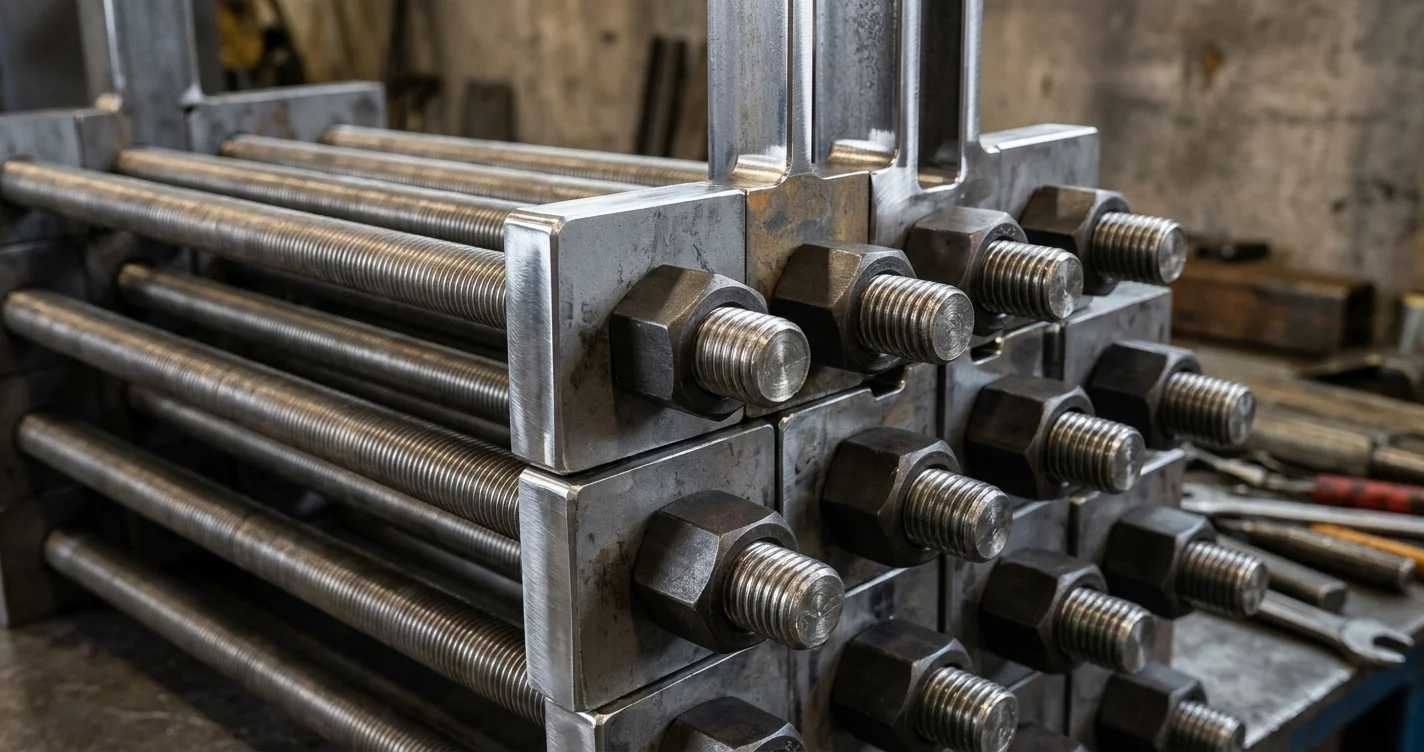
How much weight can a threaded rod hold? The answer is never just its diameter. Threaded Rod Load-Bearing Capacity depends on the steel grade, the thread size and the way the load pulls on the rod.
A 1/2″ carbon steel rod and a 1/2″ B7 rod look the same on the shelf. Their strength is very different. A wrong choice on pipe supports, HVAC hangers or anchors can mean a failed fixing and a delayed job.This guide shows you how to calculate capacity, compare grades and check your setup before you order.
It is determined by tensile stress area, material tensile strength, load direction, and the strength of connected components. The rod only carries what its weakest link allows. That link is often the nut, anchor, or support structure, not the steel itself.
Six variables control the outcome:
Multiply the tensile stress area by the material’s minimum tensile strength to get the ultimate load, then divide by a safety factor for working load. Tensile stress area is smaller than the full diameter area because threads remove material. Using nominal diameter overstates capacity.
For inch-series threads, the standard formula is:
At = 0.7854 × [d − (0.9743 / n)]²
Here, d is the nominal diameter in inches and n is threads per inch. The table uses 60 ksi carbon steel (A307-type) and 125 ksi B7 alloy steel, with a 4:1 safety factor for illustration.
| Size | Stress Area | Ultimate (60 ksi) | Working Load (4:1) | Ultimate (B7, 125 ksi) |
| 1/4″-20 | 0.0318 in² | 1,909 lb | 477 lb | 3,975 lb |
| 3/8″-16 | 0.0775 in² | 4,650 lb | 1,163 lb | 9,688 lb |
| 1/2″-13 | 0.1419 in² | 8,514 lb | 2,129 lb | 17,738 lb |
| 5/8″-11 | 0.2260 in² | 13,560 lb | 3,390 lb | 28,250 lb |
| 3/4″-10 | 0.3345 in² | 20,070 lb | 5,018 lb | 41,813 lb |
These are theoretical values. Building codes, vibration, overhead suspension, and seismic conditions can demand a higher safety factor.
Grade sets the strength ceiling for any rod size. ASTM A193 B7 alloy steel carries roughly twice the tensile load of 60 ksi carbon steel at the same diameter. Stainless steel resists corrosion but is not automatically stronger, so match the grade to both the load and the environment.
Common choices break down this way:
Grade definitions are published by standards bodies such as ASTM International, which is why material certificates matter at delivery.
Unsure which grade fits your load? Gather your design load, load direction, and site conditions before ordering. Those three inputs narrow the grade choice faster than any catalog chart.
Bending, side loads, vibration, misalignment, and weak connected hardware reduce capacity far below catalog values. Threaded rod performs best in pure tension. Real installations rarely stay that clean, so field conditions deserve as much attention as the chart.
Watch for these edge-case failure vectors:
The mechanical property classes in ISO 898-1 define what fasteners must achieve, so grade markings should always be verified.
Choose the rod by working backward from the load, environment, and installation method. Start with the required capacity, apply the correct safety factor, then select grade, diameter, and coating. Confirm that nuts and anchors match before ordering.
For light duty, such as cable tray or small pipe runs, carbon steel is usually sufficient. For heavy anchoring, move to F1554 or B7. In humid, coastal, or chemically active sites, choose stainless steel or a hot-dip galvanized finish.
Safety-critical projects need a qualified engineer to approve the final size.
Sizing a rod is a calculation first and a purchase second. Work from the tensile stress area, match the grade to the load and environment, and confirm that every nut and anchor can carry the same force. Threaded Rod Load-Bearing Capacity is never a single catalog number. It is the lowest limit across the whole assembly.
That is the standard we follow at Hamza Fasteners Building Materials Trading LLC, where grade, pitch, and coating are matched to the job before material leaves the shelf.
Wrong grade, wrong pitch, or wrong coating means a wasted trip and a delayed job. Our team can confirm the material, size, and finish that fits your load and environment before you order.
A 1/2″-13 carbon steel rod at 60 ksi has a theoretical ultimate load near 8,514 lb. With a 4:1 safety factor, working load is about 2,129 lb. A B7 rod of the same size reaches roughly 17,738 lb ultimate. Real capacity depends on load direction and anchors.
No. Stainless steel such as 304 or 316 is chosen mainly for corrosion resistance. Its tensile strength is often lower than B7 alloy steel and can be comparable to or below some carbon grades. Select it for the environment, not for extra strength.
A 4:1 factor is a common illustrative value, but the correct figure depends on building codes, vibration, overhead suspension, and seismic conditions. Dynamic or life-safety applications usually need higher factors. Confirm the value with the project engineer or authority having jurisdiction.
November 14, 2024
November 28, 2024
December 14, 2024
December 28, 2024
January 17, 2025
All Rights Reserved © Hamza Fasteners