


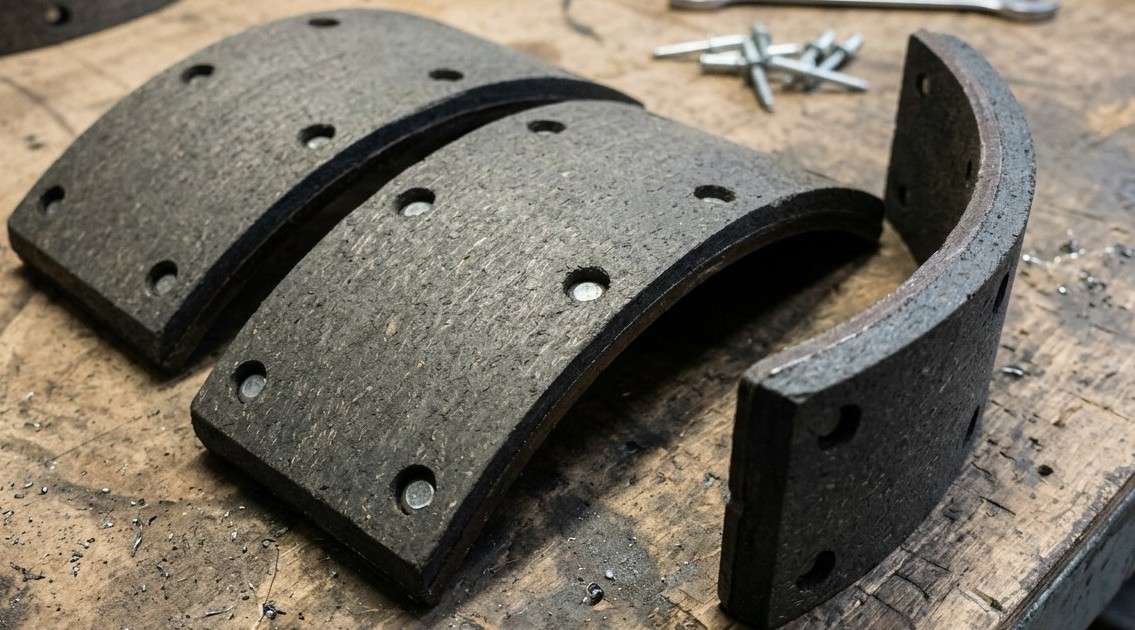
Every time a driver presses the brake pedal, the vehicle’s kinetic energy turns into heat right at the point where the lining meets the drum. On short stops this heat clears quickly. On a long downhill run or under a heavy load, that heat builds up fast and stays trapped in the brake assembly for minutes at a time.
This is where temperature resistance affects brake lining performance the most directly, deciding whether stopping power stays steady or fades away. A brake lining that can handle sustained heat keeps stopping power steady. One that cannot will fade, glaze or wear out long before it should. Understanding this relationship helps fleet owners, workshops and buyers choose a part that actually holds up in real conditions rather than just on paper.
Brake linings do not fail all at once. They move through a predictable series of changes as temperature rises, and the pattern is fairly consistent across most heavy duty friction materials.
| Temperature Range | What Happens | Result for the Driver |
| Below 180°C | Friction stays stable | Normal, predictable braking |
| 180°C to 300°C | Resin starts to soften | Mild fade under heavy use |
| 300°C to 400°C | Binder breaks down, surface oxidises | Longer stopping distance, visible wear |
| Above 400°C | Cracking and delamination risk | Lining needs immediate inspection |
This table is a good illustration of How Temperature Resistance Affects Brake Lining Performance gradually, stage by stage, rather than only at the extreme end. A lining that softens early in this range will already be losing grip long before it reaches a dangerous temperature.
Two terms come up again and again when engineers talk about heat and brakes.
Sudden fade paired with poor recovery is where real safety problems start, and it is a clear example of How Temperature Resistance Affects Brake Lining Performance well beyond a single hot stop.
A brake lining is a composite, and its ability to survive heat comes from how its ingredients work together rather than from any one part alone.
Most heavy duty linings rely on phenolic or modified resin systems. Standard resin softens quickly under load. Modified resins are built specifically to resist the heat generated by loaded trucks and trailers.
Metal and high temperature mineral fibers help move heat away from the friction surface. Friction modifiers keep the friction curve steady so the pedal feel does not change suddenly as the lining warms up.
Even a strong formula fails if mixing, pressing and curing are not controlled. Batch to batch consistency is often the real difference between two linings that look identical on a spec sheet.
One common mistake is assuming that an FMSI number tells you anything about heat performance. It only describes the shape and mounting dimensions of the lining, not the friction formula inside it. Two linings with the same FMSI number can behave very differently at 300°C.
A few direct questions to a supplier will tell you more than any marketing claim.
| Question to Ask | Why It Matters |
| Fade and recovery data available | Shows real world braking behaviour |
| Wear rate after heat cycling | Predicts service life under load |
| Batch consistency records | Confirms every unit performs the same |
| Compatibility with drum and load | Matches lining to actual usage |
If a supplier cannot answer these with data, it is worth treating the product as unverified.
A trailer running at legal weight on flat highway does not need the same thermal capacity as a truck doing repeat stop and go work or regular grade descents. The right way to judge a lining is against the worst case stop a fleet will realistically face, not the average one.
This is another place where the question of How Temperature Resistance Affects Brake Lining Performance comes up directly. A lining chosen for average conditions can fail exactly when it is needed most, on the one hard stop that pushes past its limit.
Choosing a brake lining based on price or shape alone leaves too much to chance. The real test is how it behaves after ten minutes of hard braking on a loaded descent, not how it looks in a catalogue. Checking fade, recovery and wear data before buying is a simple habit that prevents costly repairs and unsafe stops later.
For vehicles and industrial equipment operating under demanding conditions, Hamza Fasteners Building Materials Trading LLC can help you find brake linings suited to your specific application and usage pattern.
For guidance on brake lining selection and maintenance schedules, contact our team to discuss your requirements.
November 14, 2024
November 28, 2024
December 14, 2024
December 28, 2024
January 17, 2025
All Rights Reserved © Hamza Fasteners