


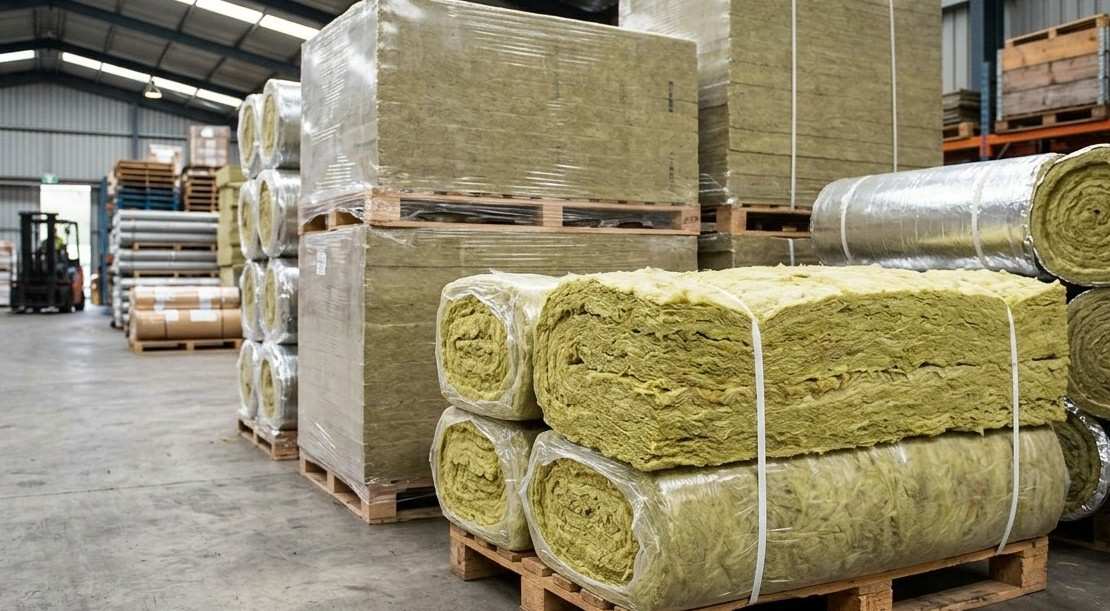
Rock wool insulation is one of the most trusted materials used across commercial and industrial projects today. Contractors and building owners choose it because it delivers thermal control, fire safety and sound reduction in a single product, and it holds up well across very different climates and building types.
Before selecting it for a project, it helps to understand the actual specifications behind the material, since these numbers determine how well it performs once installed. From density and thickness to fire rating and thermal value, each spec plays a role in whether the product suits a wall cavity, a roof system or a mechanical duct line.
Rock wool, also called mineral wool, is made from natural basalt rock and recycled slag. These raw materials are melted at very high temperatures and spun into fine fibers that trap air within a dense structure. This trapped air is what gives rock wool its strength as a thermal and acoustic barrier.
Because the material is inorganic, it does not rot, does not feed mold and holds its shape for years without sagging. Many buyers pair it directly with a rockwool insulation pin supplier so the boards stay fixed correctly from day one.
The manufacturing process plays a direct role in the specifications a buyer sees on a data sheet.
Basalt rock and industrial slag are melted in a furnace at temperatures above 1500 degrees Celsius. The molten liquid is spun at high speed into thin fibers, which are then layered and pressed into boards, slabs, mattresses or pipe sections. The final density and thickness depend entirely on how the fibers are compressed during this stage.
This controlled process is why rock wool from reputable manufacturers shows consistent performance batch after batch.
When comparing products, a few core specifications matter more than anything else. These figures decide whether the material suits a wall cavity, a roof system or an HVAC duct.
| Specification | Typical Range |
|---|---|
| Density | 40 to 200 kg/m³ |
| Thermal Conductivity | 0.035 to 0.040 W/m·K |
| Fire Rating | Class A1 (non-combustible) |
| Working Temperature | -50°C to 750°C |
| Thickness | 25 mm to 100 mm |
| Water Absorption | Less than 1% by volume |
These figures can shift slightly depending on the manufacturer, but they give a realistic picture of what to expect from a standard commercial grade product. Once the board thickness is confirmed, it is worth checking our guide on rockwool pins types uses and installation since pin length needs to match the board depth exactly.
Thermal conductivity, often shown as the K value, tells you how easily heat passes through the material. A lower K value means better insulation, and rock wool consistently performs in the 0.035 to 0.040 range, which is strong compared to many alternative products.
On the fire side, rock wool is generally classified as Class A1, meaning it is fully non combustible. It does not release smoke or toxic fumes when exposed to heat, and it can hold its structure at temperatures that would destroy most other building materials. This is exactly why it is specified so often in fire rated walls, ducts and compartment barriers, and it is also why our article on how to install rockwool pins for HVAC duct insulation focuses heavily on fire rated duct systems.
Sound performance is measured through metrics like the Noise Reduction Coefficient and Sound Transmission Class. Rock wool typically scores well on both because its fiber structure absorbs sound waves instead of reflecting them, which makes it a common choice for hotels, offices and studios where noise control matters.
On the moisture side, rock wool is naturally water repellent while still allowing vapor to pass through the material. This combination keeps the insulation dry without trapping condensation inside a wall or ceiling cavity, which helps it hold its R value even in humid conditions.
Density and thickness are often confused, but they measure different things. Density refers to how tightly the fibers are packed, while thickness refers to the physical depth of the board or slab.
Lower density boards, around 40 to 60 kg per cubic meter, are generally used for thermal applications where weight and cost matter more. Higher density boards, from 100 kg per cubic meter and above, are chosen for acoustic partitions, external cladding backing and applications where mechanical strength is required.
Common formats include
Whatever format is chosen, sourcing from a reliable rockwool pin supplier makes sure the fastening hardware matches the product density being used.
A rock wool board can meet every thermal and fire specification on paper, yet still underperform if it is not held in place correctly. Compression during installation reduces the air pockets inside the fiber structure, which directly lowers its insulating value.
This is where the right pins and fasteners become important. Using properly rated fasteners ensures the boards stay flat against the substrate without being crushed, so the material performs as intended for its full service life.
For duct work specifically, the fastening method needs to match the application closely. Our guide on rockwool pins for HVAC duct insulation walks through the correct spacing and technique for mechanical insulation projects.
Picking the correct specification depends on the application. A roof cavity needs a different density than an acoustic partition, and an HVAC line needs a pipe section rather than a flat board. Reviewing the project drawings and fire rating requirements first will narrow down the options quickly.
It also helps to understand the different pin types available before ordering fasteners in bulk. Our detailed breakdown on pin types and installation methods covers which pin suits which board thickness.
Budget is another factor that often shapes the final decision. If you are planning quantities for a larger project, our article on rockwool insulation pins price in UAE explains the main cost factors so you can plan procurement more accurately.
Rock wool insulation gives commercial projects a rare mix of thermal efficiency, fire safety, acoustic comfort and long term durability in one material. Paired with the right fastening system, it performs reliably across offices, hotels, factories and HVAC installations for many years.
Choosing quality pins and fasteners matters just as much as choosing the insulation itself. For dependable products and expert support, choose Hamza Fasteners, a trusted supplier serving commercial projects across the region.
Get in touch with our insulation fastening specialists for expert guidance and premium products for your next commercial project.
Discover in-depth guides and practical insights to help you make informed decisions across industrial fastening and engineering applications.
November 14, 2024
November 28, 2024
December 14, 2024
December 28, 2024
January 17, 2025
All Rights Reserved © Hamza Fasteners